
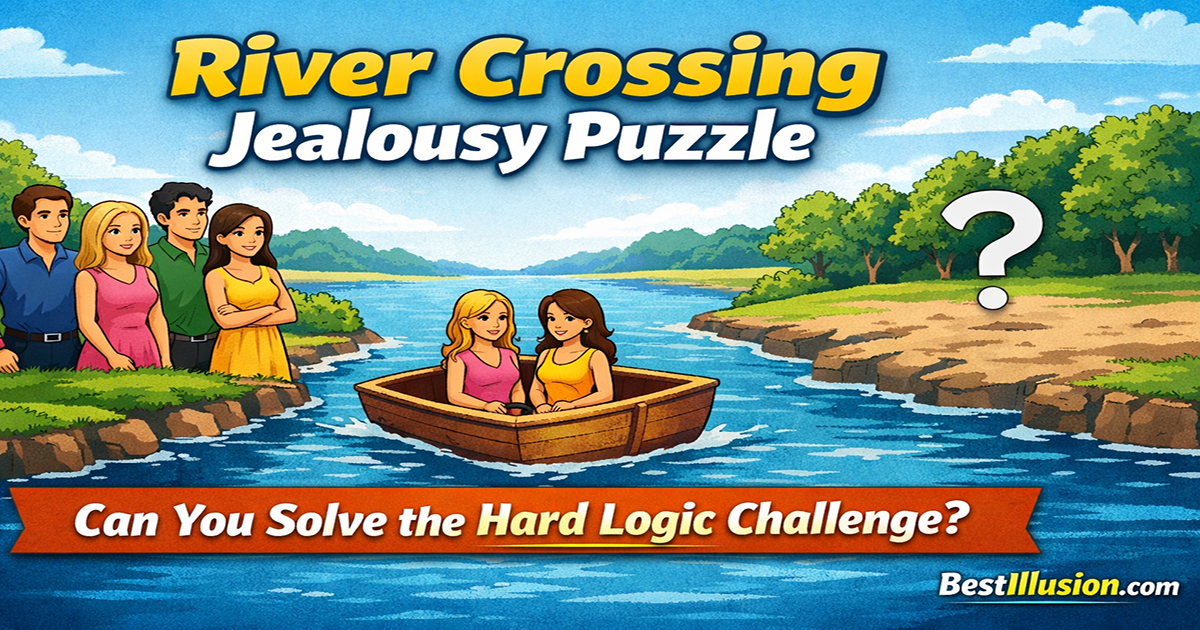
Logic puzzles have fascinated humans for centuries. They challenge assumptions, reward patience, and expose how easily rules can trip us up.
One puzzle stands out for doing all three at once: the River Crossing Jealousy Puzzle.
At first glance, it looks simple. However, as you think deeper, the constraints start to collide. Every move matters. One wrong crossing, and the rules collapse.
Before scrolling too fast, pause. This puzzle rewards slow thinking.
What Is the River Crossing Jealousy Puzzle?
The River Crossing Jealousy Puzzle is a classic logic problem involving relationships, trust, and strict movement rules.
The Setup
- Three married couples stand on one side of a river
- A boat can carry only two people at a time
- Anyone can row the boat
- The goal is to get everyone safely across
However, there’s a catch. And it changes everything.
The Jealousy Rule (Very Important)
At no time can a woman be left with another man unless her husband is present.
This rule applies:
- On either riverbank
- Inside the boat
- At every step
Because of this, many obvious moves become illegal.
Why the River Crossing Jealousy Puzzle Is So Tricky
This puzzle feels fair. Yet it punishes shortcuts.
Here’s why it’s hard:
- You must track two locations simultaneously
- The safest move often creates a future problem
- The boat’s two-person limit forces trade-offs
- Jealousy rules eliminate most intuitive crossings
As a result, brute force guessing rarely works. Instead, careful sequencing wins.
Understanding the Rules Before You Start
Before attempting the puzzle, make sure you fully understand:
- The boat must be rowed back after each crossing
- Leaving any woman alone with another man is forbidden
- Husbands act as “protectors” for their wives
- Two women together is always safe
- Two men together is always safe
Once these are clear, the logic becomes tighter.
Try to Solve It Before Revealing the Answer
Now comes the fun part.
Take a moment.
Grab a pen.
Sketch the riverbanks if needed.
Ask yourself:
- Who should move first?
- Who is safest to transport?
- Who can return the boat without breaking rules?
Warning: Most people fail on move three.
When you’re ready, scroll carefully.
🔒 Hidden Solution: Click to Reveal
Below is the entire solution, explained step by step.
No shortcuts. No skipped logic.
✅ Step-by-Step Solution
- Two women cross the river together
- One woman returns with the boat
- Two women from the original side cross
- One woman returns again
- Two women cross for the third time
- One woman returns
➡️ All women are now safely on the far side
- Two men cross together
- One man returns
- The final two men cross
🎉 Everyone is now safely across the river, and the jealousy rule was never broken.
🧠 Why This Solution Works
This approach works because:
- Women never stay with unrelated men
- Men travel only when no women are exposed
- The boat is always returned safely
- Every move preserves all constraints
The brilliance lies in grouping risk-free pairs first.
🔑 Key Takeaways from the River Crossing Jealousy Puzzle
- Constraints matter more than speed
- Safe pairs unlock difficult problems
- Logical sequencing beats trial and error
- Rules should guide strategy, not restrict creativity
Most importantly, good puzzles teach patience.
Final Thoughts: Can You Outsmart the Rules?
The River Crossing Jealousy Puzzle isn’t just a brain teaser. It’s a lesson in disciplined thinking.
If you enjoyed this challenge, you’ll love harder logic puzzles that twist assumptions even further.
👉 Share this puzzle with a friend and see who solves it faster.
👉 Explore more mind-bending riddles on BestIllusion.com.
Your brain deserves a workout.
🧠 Want another challenge?
Try this visual puzzle and test your observation skills:
👉 Find 2 Different Mushrooms Optical Illusion Challenge
Think this was easy? 👉 Try this next-level puzzle challenge.
FAQ: River Crossing Jealousy Puzzle
It’s a logic puzzle where three couples must cross a river without violating jealousy rules.
Because each move affects two locations and limits future options.
No. The two-person limit is essential to the puzzle’s difficulty.
No. There is only one valid sequence that satisfies all rules.
Logical reasoning, rule tracking, and forward planning.