
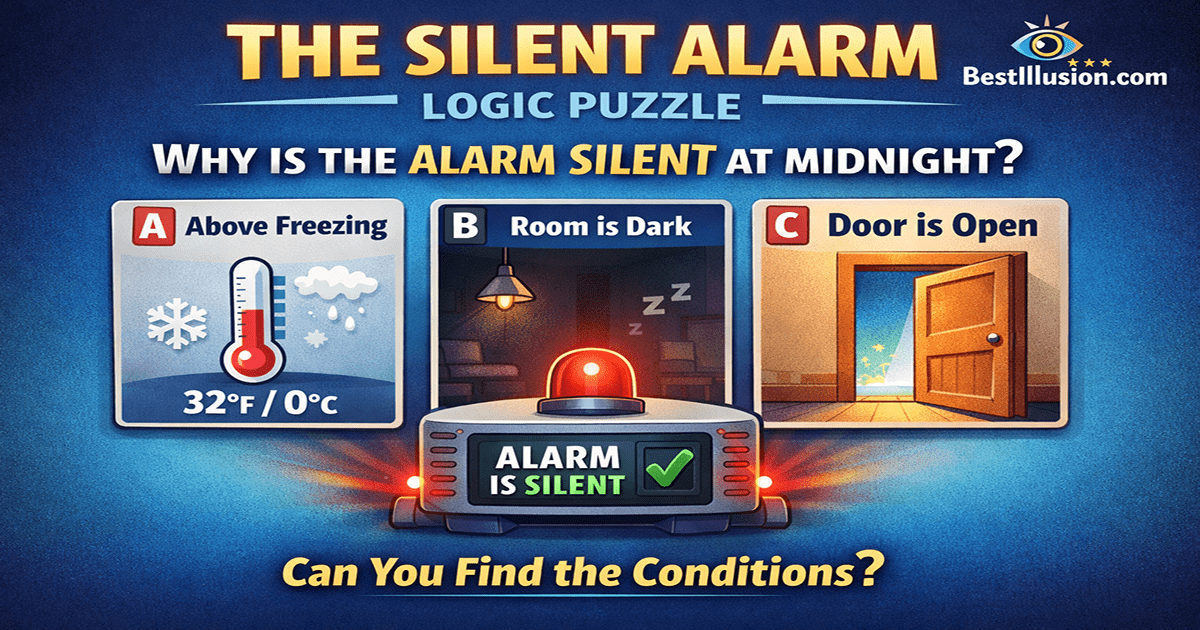
The silent alarm logic puzzle is a clever brain teaser that tests your ability to reason through conditions and rules.
At first glance, it feels simple. However, once you dig deeper, the logic becomes surprisingly tricky.
This puzzle uses three sensors and one strict rule.
The challenge is to determine what must be happening when the alarm stays silent.
Before jumping to conclusions, take a moment to think carefully.
Small details matter here, and one wrong assumption changes everything.
Puzzle Overview: The Silent Alarm Logic Puzzle
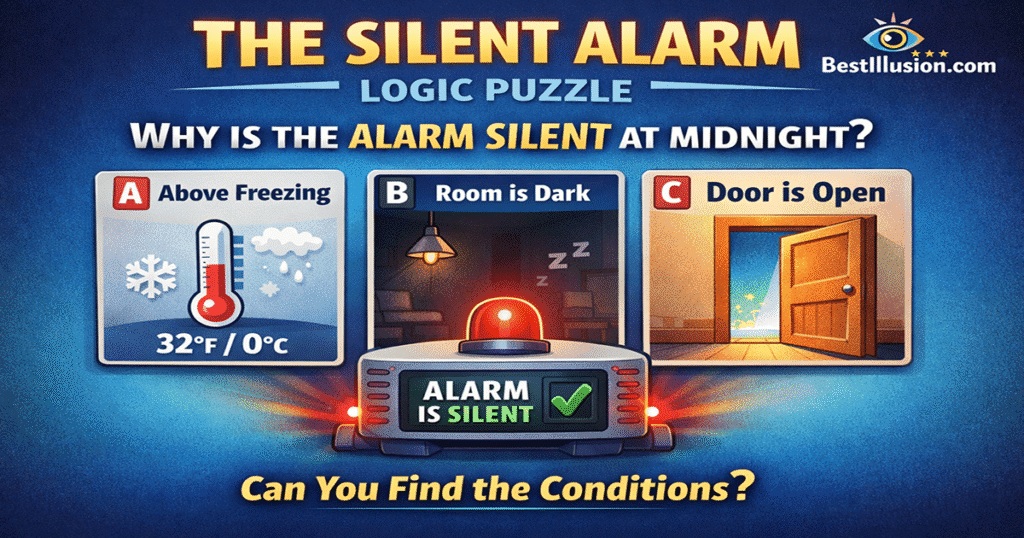
A silent alarm system triggers only if exactly one sensor is active.
There are three sensors in a room:
- Sensor A activates if the temperature is above freezing
- Sensor B activates if the room is dark
- Sensor C activates if the door is open
At midnight, the alarm does not trigger.
❓ The Big Question
What combinations of conditions could exist in the room at midnight?
Rules You Must Follow
To solve the silent alarm logic puzzle correctly, you must follow these rules:
- The alarm activates only when exactly one sensor is active
- If zero sensors are active, the alarm stays silent
- If two or three sensors are active, the alarm stays silent
- The alarm was silent at midnight
Because of this, you must focus on what combinations do NOT produce exactly one active sensor.
Why the Silent Alarm Logic Puzzle Is Tricky
This puzzle feels deceptive for one main reason.
Your brain wants to test individual conditions.
However, the correct solution depends on combinations, not single facts.
Additionally, the phrase “does not trigger” hides two different possibilities:
- Either no sensors were active
- Or multiple sensors were active
That single sentence is what makes the silent alarm logic puzzle so effective.
Try to Solve It Before Revealing the Answer
Before scrolling further, pause for a moment.
Ask yourself:
- Could the room be cold and dark?
- Could the door be open with lights on?
- What happens if everything is active?
- What happens if nothing is active?
Try listing combinations on paper.
You may be surprised how many are valid.
👇
👇
👇
🔒 Hidden Solution: Click to Reveal
Step-by-Step Solution to the Silent Alarm Logic Puzzle
Let’s solve this carefully.
Step 1: Understand When the Alarm Triggers
The alarm triggers only if exactly one sensor is active.
So, the alarm stays silent if:
- Zero sensors are active
- Two sensors are active
- All three sensors are active
Step 2: Identify Each Sensor’s Condition
- Sensor A → Temperature above freezing
- Sensor B → Room dark
- Sensor C → Door open
Each condition can be either true or false.
Step 3: List All Valid Silent Combinations
✔ Case 1: No Sensors Active
- Temperature at or below freezing
- Room not dark
- Door closed
This produces zero active sensors.
The alarm remains silent.
✔ Case 2: Exactly Two Sensors Active
Any of these combinations work:
- Above freezing + dark + door closed
- Above freezing + door open + lights on
- Dark + door open + temperature at or below freezing
Each case activates two sensors, so the alarm stays silent.
✔ Case 3: All Three Sensors Active
- Temperature above freezing
- Room dark
- Door open
Since three sensors are active, the alarm does not trigger.
Final Answer Summary
The room at midnight could have had:
- Zero active sensors
- Two active sensors
- All three sensors active
The only impossible situation is when exactly one sensor is active.
That is the complete solution to the silent alarm logic puzzle.
Key Takeaways from the Silent Alarm Brain Teaser
- The alarm reacts to exact counts, not specific conditions
- “Does not trigger” allows multiple scenarios
- Logical elimination is more powerful than guessing
- Medium puzzles often hide simple rules behind complex wording
Final Thoughts
The silent alarm logic puzzle is a perfect example of how simple rules can create deep thinking challenges.
It rewards patience, logic, and careful reading.
If you enjoyed this puzzle, explore more brain teasers and logic challenges on BestIllusion.com.
Challenge your mind daily—and don’t forget to share this puzzle with friends!
It is a reasoning puzzle where an alarm activates only under one specific sensor condition.
Because the number of active sensors is not exactly one.
Yes. When all three sensors are active, the alarm remains silent.
Yes. It is beginner-friendly but requires careful logical thinking.
It improves logical reasoning and condition-based analysis.
Try this visual puzzle and test your observation skills:
👉 Find 2 Different Mushrooms Optical Illusion Challenge
🧩 Love tricky puzzles?
Try this clever brain teaser next:
👉 Missing Coin Mystery – A Clever Brain Teaser Explained
Think your eyes are fast? Try this 20-second spot-the-difference challenge.