
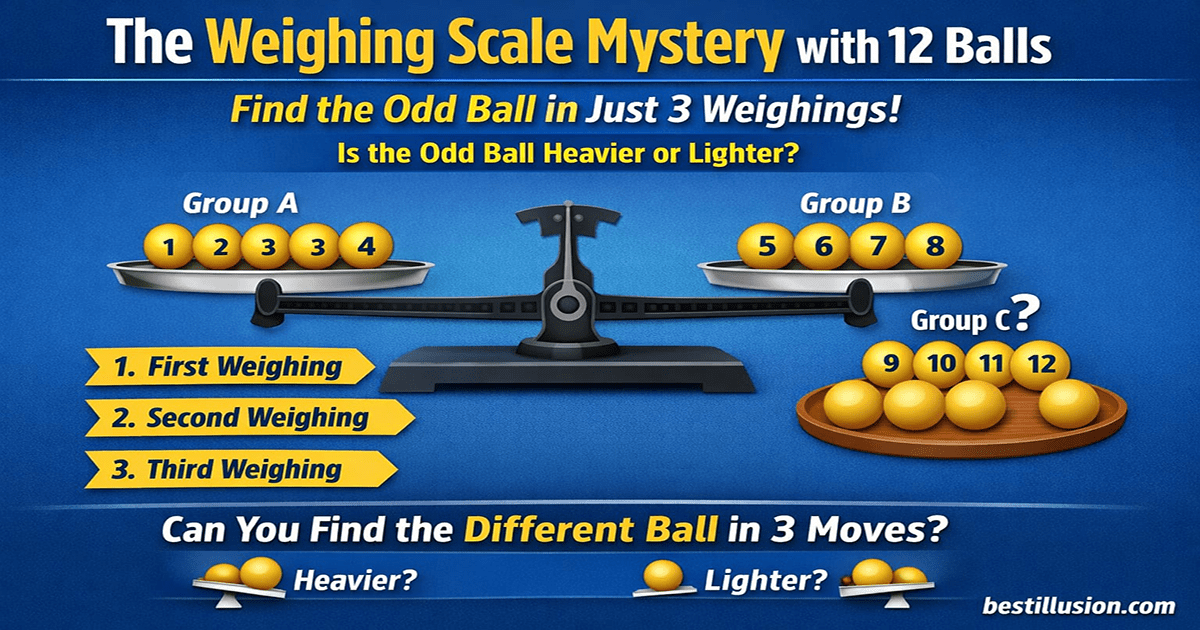
Brain teasers have fascinated humans for centuries, and among them, the Weighing Scale Mystery with 12 Balls stands out as one of the most famous logic puzzles ever created. This classic problem challenges your reasoning skills, patience, and ability to think strategically.
You are given 12 identical-looking balls. However, there is a catch—one ball is different. It could be heavier or lighter, and you do not know which. Your only tool is a balance scale, and you are allowed to use it only three times.
👉 Your mission:
Find which ball is different and determine whether it is heavier or lighter—using just three weighings.
At first glance, this may seem impossible. However, with careful planning and logical thinking, the puzzle has a precise and elegant solution.
Let’s break it down step by step.
Understanding the Weighing Scale Mystery with 12 Balls
Before jumping into the solution, it is important to understand the constraints:
- All 12 balls look exactly the same
- Only one ball has a different weight
- The odd ball could be heavier or lighter
- You are allowed exactly three weighings
- A balance scale only shows heavier, lighter, or balance
Because of these strict rules, guessing will not work. You must use a logical elimination strategy.
Solution
Step 1: First Weighing in the Weighing Scale Mystery with 12 Balls
Divide the balls into three groups of four:
- Group A: Balls 1–4
- Group B: Balls 5–8
- Group C: Balls 9–12
Weigh Group A against Group B.
Possible Outcomes
- The scales balance
- Group A is heavier
- Group B is heavier
Each outcome leads to a different logical path.
Case 1: Balanced Scale in the Weighing Scale Mystery
If Group A and Group B balance, all eight balls are normal. This means the odd ball must be in Group C (balls 9–12).
Second Weighing
Weigh balls 9, 10, and 11 against three known normal balls from Group A.
- If the scale balances → Ball 12 is the odd one
- If the scale tips → one of balls 9, 10, or 11 is odd, and the direction tells you whether it is heavier or lighter
Third Weighing
Compare any two of the remaining suspect balls:
- If one side is heavier, that ball is the odd one
- If they balance, the remaining ball is the odd one
✅ The odd ball and its weight are identified in three weighings.
Case 2: Group A Is Heavier Than Group B
If Group A is heavier, then one of two things must be true:
- A ball in Group A is heavier, or
- A ball in Group B is lighter
Second Weighing
Compare balls 1, 2, and 5 against balls 3, 9, and 10 (where 9 and 10 are known normal balls).
- If the scale balances → the odd ball is among balls 4, 6, 7, or 8
- If the scale tips → the direction immediately reveals whether the odd ball is heavy or light and narrows the suspects
Third Weighing
Compare the remaining suspects directly:
- The heavier or lighter result reveals the exact odd ball
- The direction confirms whether it is heavier or lighter
Case 3: Group B Is Heavier Than Group A
This case is symmetrical to Case 2.
Simply reverse the roles of Group A and Group B. By using the same logic, the third weighing always identifies:
- Which ball is different
- Whether it is heavier or lighter
✅ Final Solution (Clear Conclusion)
After three carefully planned weighings:
- The odd ball is always uniquely identified
- Its weight difference (heavier or lighter) is known with certainty
There is no guessing involved. Every possible outcome of the three weighings leads to one logical conclusion.
Therefore, it is mathematically guaranteed that the odd ball among 12 identical balls can be found in just three weighings.
Quick Solution Box
Quick Solution Box
Short on time? Here’s the solution in one glance:
- Weighing 1: Compare 4 balls vs 4 balls
- If they balance → the odd ball is in the remaining 4
- If they don’t → you already know whether the odd ball is heavy or light
- Weighing 2: Mix known normal balls with suspects
- This narrows the problem to 2–3 balls and often confirms heavy or light
- Weighing 3: Compare the final suspects
- The scale result uniquely identifies the odd ball and its weight
✅ Guaranteed result: In exactly three weighings, you will always find which ball is different and whether it is heavier or lighter.
Why the Weighing Scale Mystery with 12 Balls is So Brilliant
The brilliance of the Weighing Scale Mystery with 12 Balls lies in how it uses information rather than numbers. Each weighing gives maximum insight, and no step is wasted.
This is why the puzzle is often used in:
- Logic competitions
- IQ tests
- Engineering and math interviews
- Critical thinking exercises
It teaches planning, deduction, and structured thinking.
Final Thoughts
If you followed the solution, congratulations—you’ve mastered one of the most famous logic puzzles in history. Even if it took time, solving puzzles like this sharpens your reasoning skills.
Brain teasers are not just games; they train your mind to think clearly and logically.
Ready for another challenge? Keep exploring more classic puzzles and logic mysteries.
You can always find the odd ball in exactly three weighings, no more, no less.
Yes, the odd ball may be either heavier or lighter; the solution works for both cases.
Use a systematic elimination method, dividing balls into groups and comparing them logically to narrow down the suspects.