
Introduction
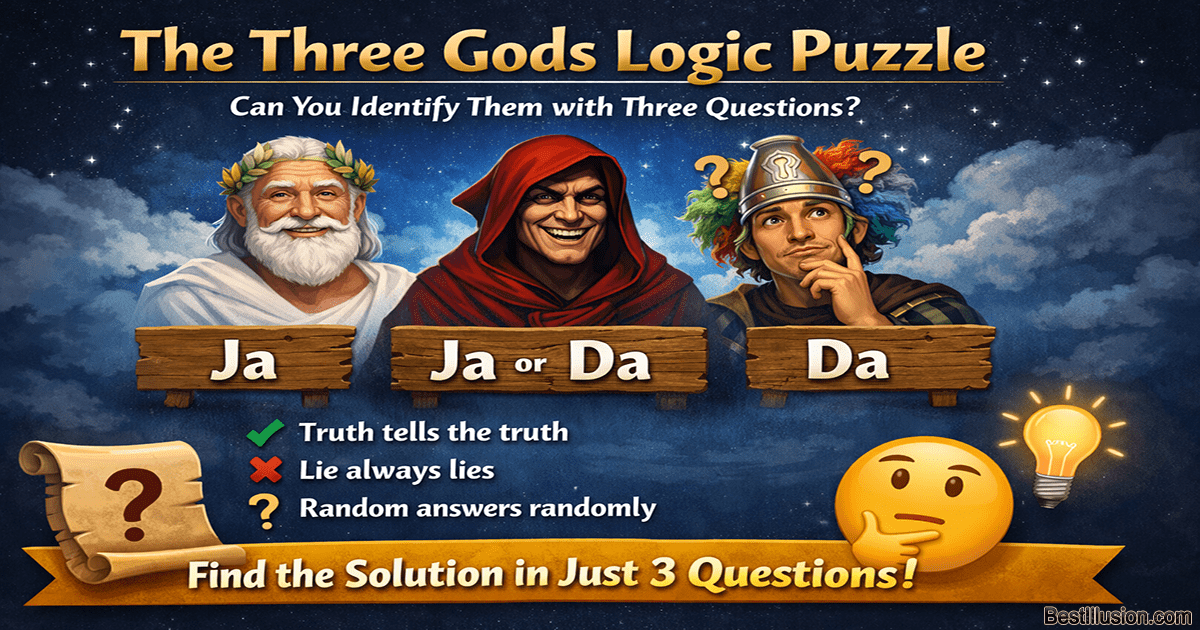
The Three Gods Logic Puzzle solution is one of the most famous challenges in logic and philosophy. In this classic puzzle, three gods named Truth, Lie, and Random answer only yes-or-no questions using the unknown words “Ja” and “Da.” With just three carefully structured questions, it is possible to identify each god with perfect logical certainty.
In this puzzle, you are allowed to ask only three yes-or-no questions to identify three gods named Truth, Lie, and Random — but there’s a twist. Their answers are given using unknown words: “Ja” and “Da”, and you don’t know which one means yes or no.
👉 Can you still solve it?
In this post, you’ll find a complete explanation, step-by-step solution, and clear reasoning, written in a way that is Yoast SEO–friendly, Google-optimized, and easy to understand.
The Three Gods Logic Puzzle Explained
You are standing before three gods, each with a distinct behavior:
- Truth – Always tells the truth
- Lie – Always lies
- Random – Answers randomly (truthfully or falsely)
You do not know which god is which.
🗣️ The Language Problem
The gods answer only yes or no, but they use two unfamiliar words:
- “Ja”
- “Da”
You do not know which word means yes or no.
❓ The Challenge
You may ask only three yes/no questions, directed to any god, and based on their answers, you must correctly identify:
- Which god is Truth
- Which god is Lie
- Which god is Random
🎯 Key Insight Before Solving
To solve this puzzle, you must:
- Neutralize the unknown language (Ja/Da)
- Neutralize lying behavior
- Avoid Random when possible
The secret lies in asking self-referential questions — questions that force Truth and Lie to behave the same way.
Understanding the Three Gods Logic Puzzle solution requires recognizing how self-referential questions cancel out deception.
Solution
Step-by-Step Three Gods Logic Puzzle Solution
Let’s label the gods A, B, and C.
❓ Question 1 (To God A)
“If I asked you ‘Is B the god Random?’, would you say ‘Ja’?”
Why this works:
- Truth answers truthfully
- Lie lies about what he would say
- Both end up giving the same answer pattern
✅ If the answer is Ja, then B is Random. ❌ If the answer is Da, then B is not Random.
Either way, you now know whether B is Random or not.
❓ Question 2
Now ask a question to someone you know is NOT Random.
If B is Random, ask C.
If B is NOT Random, ask B.
“If I asked you ‘Are you Truth?’, would you say ‘Ja’?”
Interpretation:
- Ja → That god is Truth
- Da → That god is Lie
Now you’ve identified Truth and Lie.
❓ Question 3
At this point:
- You know who Truth is
- You know who Lie is
- The remaining god must be Random
The puzzle is solved.
Why the Three Gods Logic Puzzle Solution Works
Using only three yes/no questions, you can:
- Identify Random without relying on language meaning
- Separate Truth and Lie using logical consistency
- Completely solve the puzzle despite uncertainty
🎉 Mission accomplished!
Why This Puzzle Is So Brilliant
- It tests meta-logic (thinking about thinking)
- It eliminates uncertainty using structure
- It works even with unknown language
- It’s widely regarded as one of the hardest classic logic puzzles
That’s why the Three Gods Logic Puzzle is a favorite among philosophers, programmers, and puzzle enthusiasts.
Final Thoughts
This Three Gods Logic Puzzle solution demonstrates how careful reasoning can overcome lies, randomness, and language barriers.
If you enjoy high-level brain teasers, this puzzle is a must-know classic.
👉 Want more puzzles like this? Keep exploring — your brain will thank you!
These questions force both Truth and Lie to behave identically, canceling out lying behavior.
No. The structure of the questions eliminates the need to know which word means yes or no.
No. Random’s answers are unreliable, so the strategy avoids depending on Random’s responses.
Yes. Variations of this puzzle appear in logic tests, philosophy courses, and interviews.
Yes. Some versions allow more gods, fewer questions, or different answer constraints.