
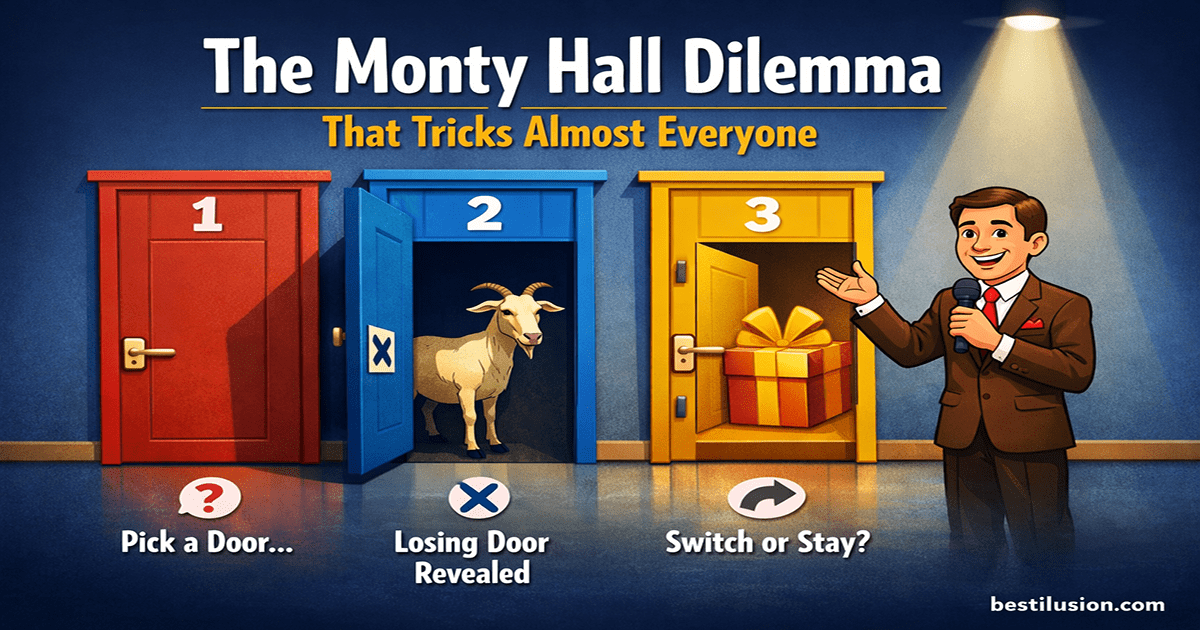
The Monty Hall Dilemma is one of the most famous probability puzzles ever created.
It looks simple. Yet, it confuses millions.
You choose one of three doors.
Behind one door is a prize.
The host then opens one losing door.
Finally, you get a choice: stay or switch.
At this point, many people freeze.
Some trust instinct. Others trust math.
Before jumping to conclusions, slow down.
This puzzle rewards careful thinking.
👉 Try to solve it yourself before scrolling.
Understanding the Rules of the Puzzle
To analyze the Monty Hall Dilemma, the rules must be clear.
Here is what always happens:
- You pick one door
- The host knows where the prize is
- The host never opens the prize door
- The host always opens a losing door
- You are always offered a switch
Nothing here is random.
That detail matters more than it seems.
Why the Monty Hall Dilemma Feels So Tricky
The Monty Hall Dilemma challenges intuition.
At first glance, it feels like a 50–50 choice.
Two doors remain. One prize exists.
However, the human brain loves symmetry.
Probability does not.
Also, people ignore the host’s role.
Yet, the host’s knowledge changes everything.
Because of this, even mathematicians argued about this puzzle for years.
Monty Hall Dilemma Advanced Insight: What Most People Miss
The key misunderstanding is assuming the host’s action gives no information.
That assumption is false.
The host’s decision is conditional.
It depends on your first choice.
Because of that dependency, probabilities shift.
They do not reset.
This is where deeper insight begins.
⏸️ Try to Solve It Before Revealing the Answer
Before reading the solution, pause here.
Ask yourself:
- Does switching really help?
- Why would probabilities change?
- What role does the host actually play?
Think it through slowly.
Trust logic over instinct.
People often fails in probability problems — just like in the switch and bulb logic puzzle or the Three Symbols Puzzle.
👇 When ready, continue.
🔒 Hidden Solution: Click to Reveal
Step-by-Step Explanation of the Monty Hall Dilemma
Let’s break it down cleanly.
Step 1: Your first choice
When you choose one door, the chance you picked the prize is 1 out of 3.
That equals 33.3%.
Therefore, the chance the prize is behind one of the other two doors is 66.7%.
Step 2: The host opens a losing door
The host removes one wrong door from the two you did not choose.
This action is not random.
The host avoids the prize on purpose.
Step 3: Probabilities do not reset
Your original door still has a 33.3% chance of being correct.
The remaining unopened door now holds the entire 66.7% probability.
Why?
Because the host filtered information for you.
Step 4: Final decision
- Staying keeps your 33.3% chance
- Switching gives you 66.7% chance
Switching doubles your odds.
Final Answer:
✅ You should always switch doors.
📌 Key Takeaways from the Monty Hall Dilemma
Intuition often fails in probability problems
Your first choice is unlikely to be correct
The host’s knowledge affects probabilities
The puzzle is about conditional probability
Switching is always the smarter move
Final Thoughts: Challenge Your Intuition
The Monty Hall Dilemma proves a powerful lesson.
What feels obvious is not always correct.
Logic beats instinct—especially in probability.
If this puzzle surprised you, that’s good.
It means your brain just leveled up.
👉 Share this puzzle, challenge a friend, or explore more brain teasers to sharpen your thinking.
If you enjoyed this counterintuitive challenge, try the Missing Coin Mystery or explore more logic puzzles here.
Yes. It was based on a real game show scenario.
No. But it wins twice as often as staying.
Then the probabilities change. The classic solution no longer applies.
Yes. It is proven using conditional probability and simulations.
Because intuition clashes with mathematical logic.
More Brain Teasers You Might Like: