
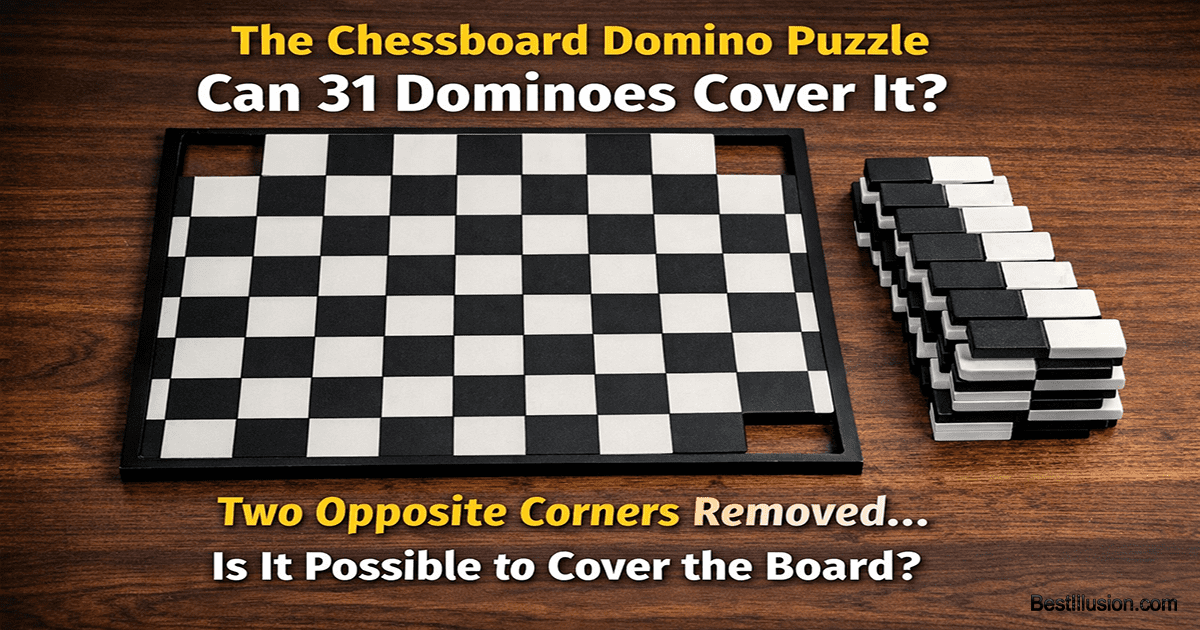
The chessboard domino puzzle is one of the most famous logic puzzles ever created. At first glance, it looks simple. However, once you dig deeper, it becomes surprisingly tricky.
In this puzzle, you are given a standard chessboard with two opposite corner squares removed. You also have 31 dominoes, and each domino covers exactly two adjacent squares.
Your challenge is straightforward:
👉 Can the entire board be completely covered using all 31 dominoes?
Before jumping to conclusions, take a moment. Many people think the answer is obvious — and they are wrong.
Let’s explore the rules, why this puzzle is deceptive, and how to think about it logically.
🧩 Puzzle Rules and Setup
To understand the chessboard domino puzzle, you must follow these exact rules:
- The board is an 8×8 chessboard.
- Two opposite corner squares are removed.
- You have 31 identical dominoes.
- Each domino covers exactly two adjacent squares.
- Dominoes cannot overlap or extend outside the board.
No tricks. No rotations off the board. Just pure logic.
🤔 Why the Chessboard Domino Puzzle Is So Tricky
This puzzle feels solvable because the math appears to work.
- A full chessboard has 64 squares.
- Removing two squares leaves 62 squares.
- Each domino covers 2 squares.
- 31 dominoes × 2 squares = 62 squares
Perfect match, right?
However, logic puzzles often hide their difficulty beneath correct arithmetic. This puzzle tests pattern recognition, not just counting.
That is exactly why the chessboard domino puzzle has confused mathematicians, students, and puzzle lovers for decades.
🧠 Think Before You Scroll: Try to Solve It Yourself
Before revealing the answer, ask yourself these questions:
- What makes a chessboard unique?
- Does color matter?
- Do dominoes care which squares they cover?
- Is every square truly equal?
Take a minute. Visualize the board. Try to place the dominoes mentally.
Most people miss one crucial detail.
👇 Don’t scroll yet if you want the full challenge.
🔒 Hidden Solution: Click to Reveal
❌ The Board Cannot Be Completely Covered
Here’s the step-by-step explanation.
Step 1: Understand the chessboard pattern
A chessboard always has alternating colors: black and white.
There are 32 black squares and 32 white squares.
Step 2: Observe the removed corners
Opposite corners on a chessboard are always the same color.
So when you remove two opposite corners, you remove two squares of the same color.
This leaves:
- 30 squares of one color
- 32 squares of the other color
Step 3: Analyze the dominoes
Each domino always covers one black square and one white square.
It can never cover two squares of the same color.
Step 4: Identify the imbalance
Since the remaining board has an unequal number of black and white squares, it is impossible for dominoes to cover every square.
Final Conclusion:
Because each domino requires one square of each color, and the board no longer has equal colors, the chessboard domino puzzle has no solution.
Key Takeaways from the Chessboard Domino Puzzle
- Logic puzzles are not always about numbers.
- Visual patterns matter more than arithmetic.
- Chessboard coloring is a powerful analytical tool.
- Symmetry can reveal hidden constraints.
- Simple puzzles can teach deep reasoning skills.
This is why the chessboard domino puzzle is still taught in math and logic classes today.
Final Thoughts: Can You Outsmart the Board?
The chessboard domino puzzle is a perfect example of how intuition can fail us. While the numbers suggest success, logic proves otherwise.
If you enjoyed this puzzle, challenge a friend and watch them fall into the same trap. Even better, explore more classic logic riddles that sharpen your thinking skills.
👉 Want more mind-bending puzzles like this? Bookmark this page and share it with fellow puzzle lovers! 🧠♟️
No. The puzzle is unsolvable because removing two opposite corners creates a color imbalance.
Each domino covers two adjacent squares, which are always opposite colors on a chessboard.
Yes. If one black and one white square were removed, the puzzle could be solvable.
Absolutely. It is commonly used to teach proof, reasoning, and invariants.
Yes, once you understand the color logic, no diagram is needed.