
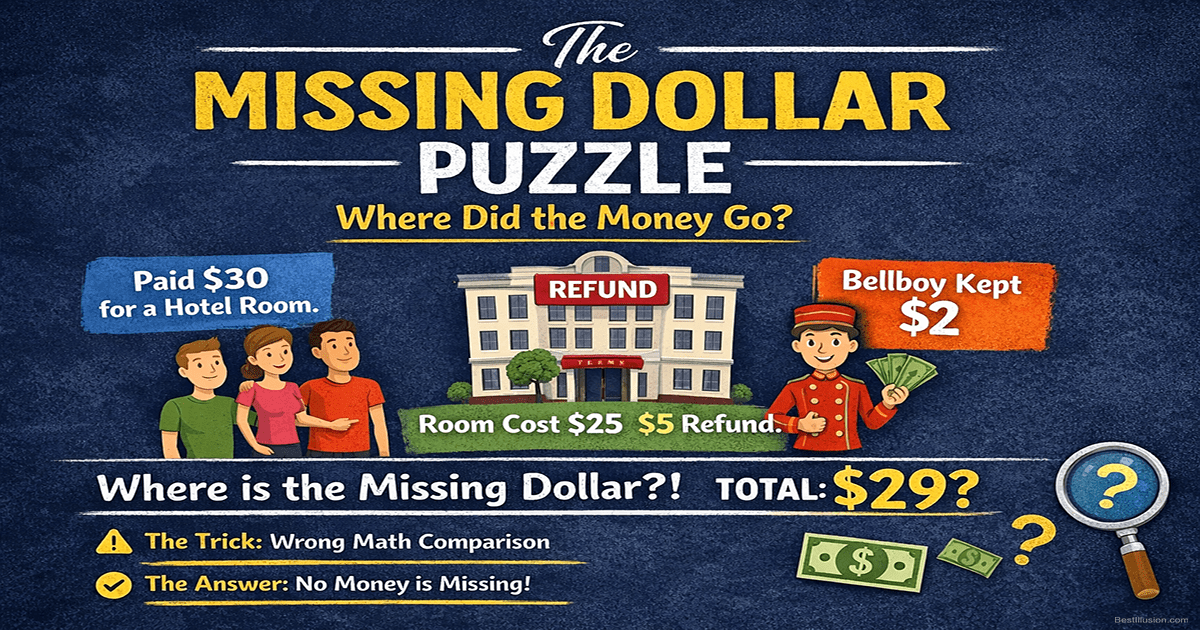
Brain teasers have a unique way of challenging how we think. Among the most famous logic puzzles ever created is The Missing Dollar Puzzle. At first glance, it looks like a simple math problem. However, once you try to solve it, confusion sets in quickly.
Many people believe there is a missing dollar, but in reality, no money disappears at all. In this article, we will break down the puzzle step by step and clearly explain why the confusion happens.
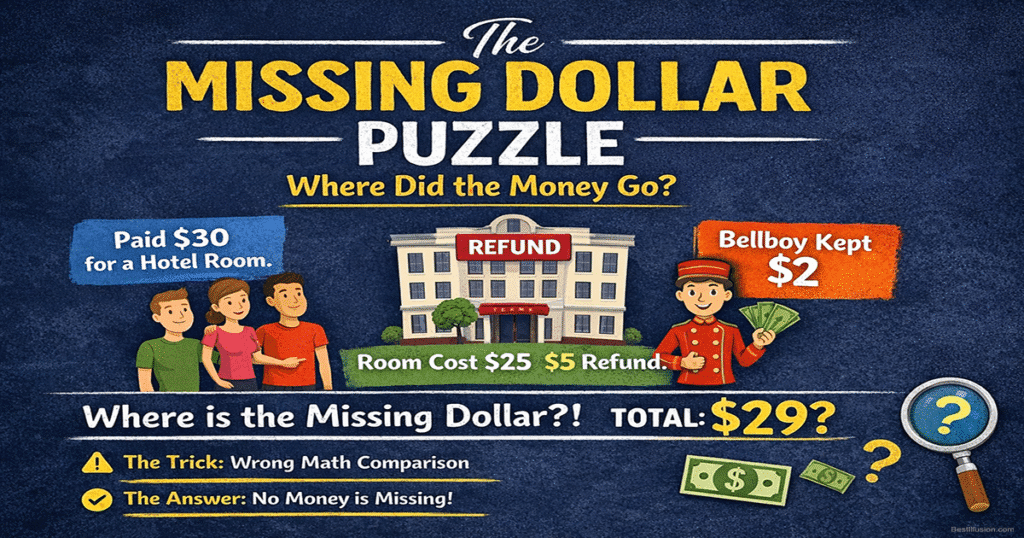
The Missing Dollar Puzzle
Here is the puzzle exactly as it is usually presented:
Three people check into a hotel room that costs $30.
They each pay $10, totaling $30.Later, the hotel manager realizes the room actually costs $25 and gives $5 to the bellboy to return to the guests.
The bellboy gives $1 back to each person and secretly keeps $2.
Now each person has paid $9, which totals $27.
Add the bellboy’s $2, and the total becomes $29.Where is the missing dollar?
At this point, most readers feel something is wrong—but cannot identify exactly what.
Why This Puzzle Is So Confusing
This confusion occurs because the puzzle mixes two different calculations that should never be added together.
Now let’s slow down and look at the numbers logically.
Solution
The Missing Dollar Puzzle Explained Step by Step
Step 1: Total Money Paid
- The guests initially pay:
$10 × 3 = $30
Step 2: Actual Cost of the Room
- The room costs $25
Step 3: Returned Money
- Refund given to bellboy: $5
- Bellboy keeps: $2
- Guests get back: $3 ($1 each)
What Did the Guests Really Pay?
Each guest gets $1 back, so:
- Original payment per person: $10
- Refund per person: $1
- Actual payment per person: $9
Total paid by guests:
$9 × 3 = $27
Now let’s see where this $27 goes:
- $25 → Hotel
- $2 → Bellboy
$25 + $2 = $27 ✅
Everything is accounted for.
So, Where Is the Mistake?
The mistake happens here:
“Each person paid $9 (total $27). Add the bellboy’s $2 to get $29.”
This step is logically incorrect.
❌ Why?
Because the $2 kept by the bellboy is already included in the $27.
You are adding it twice, which creates the illusion of missing money.
The Correct Way to Think About It
Instead of adding:
- $27 (paid) + $2 (bellboy)
You should compare:
- $30 (original payment)
- $25 (hotel) + $3 (returned to guests) + $2 (bellboy)
$25 + $3 + $2 = $30 ✔️
No dollar is missing.
Why the Missing Dollar Puzzle Is Brilliant
This puzzle works because:
- It uses misdirection
- encourages incorrect addition
- exploits how our brains handle numbers under pressure
As a result, even highly intelligent people get tricked.
What the Missing Dollar Brain Teaser Teaches Us
The Missing Dollar Puzzle teaches an important lesson:
- Always check what numbers represent
- Do not mix costs and payments
- Logical thinking is more important than quick math