
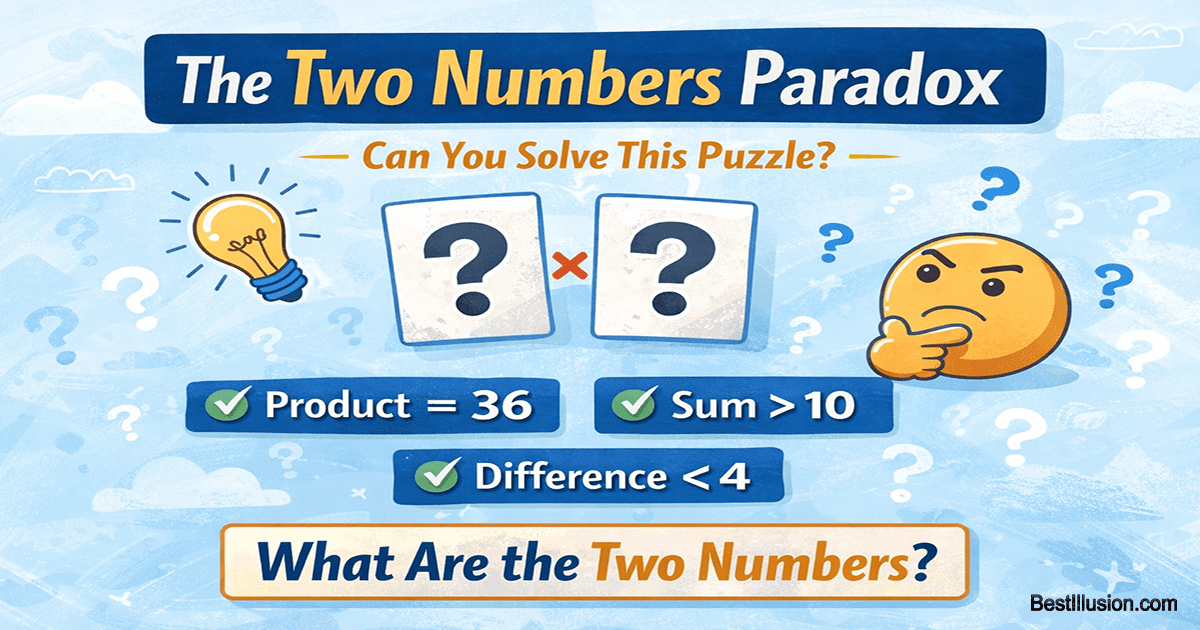
Puzzles based on numbers often appear simple at first glance, but when examined closely, they reveal layers of logic, reasoning, and mathematical curiosity. One such puzzle is The Two Numbers Paradox, a clever challenge that requires analyzing conditions step-by-step until only one answer remains. In this post, we’ll break down the puzzle in an intuitive way, explore all possible combinations, test them against the given clues, and finally reveal why this paradox is such a fun brain teaser.
This puzzle is great for puzzle-lovers, students, bloggers, or anyone who enjoys logical thinking. It can also be used as a classroom warm-up, an interview puzzle, or even a fun game with friends.
🧩 The Puzzle
The challenge is simple:
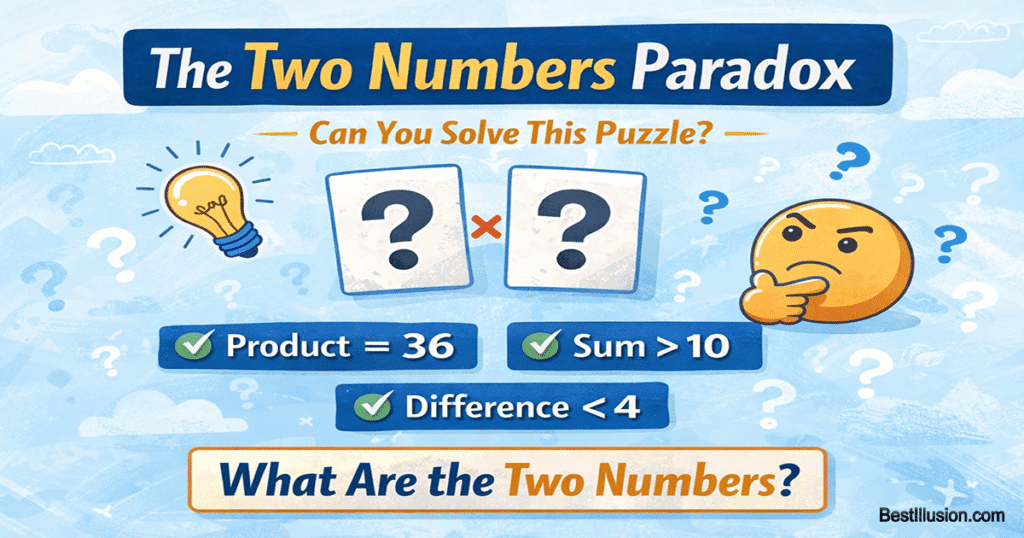
I am thinking of two numbers.
• Their product is 36
• Their sum is greater than 10
• Their difference is less than 4
Why the Two Numbers Paradox Confuses Many People
At first, the puzzle seems straightforward. But when you begin examining all the number pairs that multiply to 36, you’ll see why this is called a paradox—it seems to have many answers, but only one pair truly satisfies all conditions simultaneously.
Let’s explore the logic behind it step by step.
Solution
Solving the Two Numbers Paradox Using Logic
Step 1: List All Pairs With a Product of 36
To solve the puzzle, we start with the most concrete clue: the product of the two numbers is 36.
Here are all positive integer pairs whose product equals 36:
| Number 1 | Number 2 | Product |
|---|---|---|
| 1 | 36 | 36 |
| 2 | 18 | 36 |
| 3 | 12 | 36 |
| 4 | 9 | 36 |
| 6 | 6 | 36 |
These five number pairs form our starting pool of possibilities.
Step 2: Apply Clue 2 — The Sum Must Be Greater Than 10
Now we remove any pairs that do not have a sum greater than 10.
Let’s check each one:
- 1 + 36 = 37 → ✔ Greater than 10
- 2 + 18 = 20 → ✔ Greater than 10
- 3 + 12 = 15 → ✔ Greater than 10
- 4 + 9 = 13 → ✔ Greater than 10
- 6 + 6 = 12 → ✔ Greater than 10
Interestingly, all pairs still remain valid.
That is why this puzzle becomes more interesting: the first two clues alone don’t eliminate anything.
Step 3: Apply Clue 3 — The Difference Must Be Less Than 4
Now we check the final condition.
We look at the absolute difference between the two numbers:
- |1 – 36| = 35 → ❌ greater than 4
- |2 – 18| = 16 → ❌ greater than 4
- |3 – 12| = 9 → ❌ greater than 4
- |4 – 9| = 5 → ❌ greater than 4
- |6 – 6| = 0 → ✔ less than 4
Only one pair satisfies all three clues:
🎉 The Two Numbers Are: 6 and 6
This is the only combination that:
✔ Multiplies to 36
✔ Has a sum greater than 10
✔ Has a difference less than 4
Every other pair fails at least one condition.
Final Answer to the Two Numbers Paradox
The two numbers are 6 and 6.
This is the only pair that meets all three requirements.
Why This Puzzle Is Called a Paradox
The puzzle is sometimes referred to as a paradox because:
- At first, it seems like it should have several answers.
- The sum condition does not eliminate any of the possible candidates.
- Only the final small clue—the difference—reveals the true answer.
This creates an illusion that the puzzle is trickier than it is, leading people to second-guess themselves. Many assume there must be a deeper twist, hidden trick, or unexpected solution. But in reality, the answer is completely straightforward once examined step by step.
A Deeper Look: Could Negative Numbers Be Solutions?
Let’s consider an interesting extension: could the two numbers be negative?
Negative numbers can also multiply to 36:
- (–1, –36)
- (–2, –18)
- (–3, –12)
- (–4, –9)
- (–6, –6)
But these pairs immediately fail the second condition:
The sum must be greater than 10, and all these sums are very negative.
So negative possibilities are impossible.
What This Two Numbers Paradox Teaches About Logical Reasoning
The Two Numbers Paradox is valuable because it reinforces several key problem-solving strategies:
1. Start With the Concrete Facts
The product condition gives a fixed set of candidates. Always list them first.
2. Apply Each Condition One at a Time
Do not try to solve all conditions simultaneously. Eliminating options stepwise makes puzzles easier.
3. Don’t Overthink Simple Clues
Many people assume the puzzle is more complex than it actually is. Logical puzzles reward patience more than clever shortcuts.
Conclusion
The Two Numbers Paradox is a fun and satisfying puzzle that demonstrates how powerful structured reasoning can be. By simply listing all possibilities and eliminating options one clue at a time, we quickly arrive at the correct answer. It’s the kind of puzzle that seems mysterious at first but becomes perfectly clear with logical analysis.
Whether you’re preparing content for your blog, improving your puzzle-solving skills, or just enjoying brain teasers, this paradox is a great example of how numbers can surprise us. Feel free to share it with your audience or challenge your friends to solve it!