
🔍 Introduction
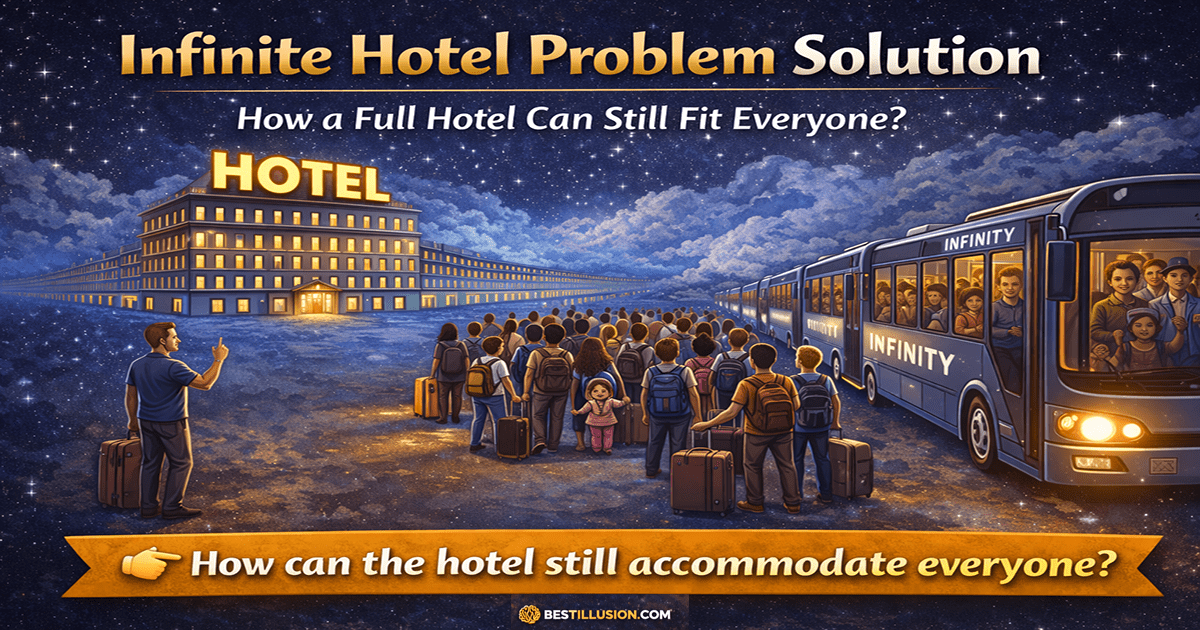
The Infinite Hotel Problem solution explains one of the most mind-bending ideas in mathematics and philosophy: how a hotel with infinitely many rooms can still accommodate more guests—even when every room is already full. This famous thought experiment challenges our everyday understanding of infinity and reveals why infinite sets behave very differently from finite ones.
If you’ve ever wondered how logic can defeat common sense, the Infinite Hotel Problem is a perfect example.
🏨 What Is the Infinite Hotel Problem?
The Infinite Hotel Problem, also known as Hilbert’s Hotel, is a thought experiment created by mathematician David Hilbert. The hotel has:
- Infinitely many rooms (Room 1, Room 2, Room 3, …)
- Every room occupied
Despite being completely full, the hotel manager can still accommodate more guests using clever room reassignment.
This paradox illustrates key ideas behind infinity, set theory, and mathematical logic.
🧠 Key Concept Behind the Infinite Hotel Problem Solution
The core idea of the Infinite Hotel Problem solution is that:
An infinite set can remain the same size even after adding more elements.
This is impossible with finite sets, but infinity follows different rules.
👤 Case 1: One New Guest Arrives
❓ The Problem
The hotel is full. A single new guest arrives.
✅ The Solution
The manager asks:
- Guest in Room 1 → move to Room 2
- Guest in Room 2 → move to Room 3
- Guest in Room 3 → move to Room 4
- And so on…
Room 1 becomes free for the new guest.
✔ Everyone keeps a room
✔ One new guest is accommodated
This simple shift demonstrates the power of infinity.
👥 Case 2: 100 New Guests Arrive
❓ The Problem
Now 100 new guests arrive at once.
✅ The Solution
The manager instructs each guest:
“Move from Room n to Room n + 100.”
This frees up:
- Room 1 through Room 100
These 100 empty rooms are assigned to the new guests.
✔ Original guests stay accommodated
✔ 100 new guests get rooms
The Infinite Hotel Problem solution works effortlessly again.
🚌 Case 3: Infinitely Many Buses with Infinitely Many Passengers
❓ The Ultimate Challenge
Now things get extreme:
- Infinitely many buses arrive
- Each bus contains infinitely many passengers
At first glance, this seems impossible.
Solution
✅ The Solution
The manager instructs each guest:
“Move from Room n to Room n + 100.”
This frees up:
- Room 1 through Room 100
These 100 empty rooms are assigned to the new guests.
✔ Original guests stay accommodated
✔ 100 new guests get rooms
The Infinite Hotel Problem solution works effortlessly again.
🚌 Case 3: Infinitely Many Buses with Infinitely Many Passengers
❓ The Ultimate Challenge
Now things get extreme:
- Infinitely many buses arrive
- Each bus contains infinitely many passengers
At first glance, this seems impossible.
✅ The Elegant Solution
The manager uses a mathematical trick:
- Assign each current guest to even-numbered rooms:
- Guest in Room n → Room 2n
- This frees all odd-numbered rooms:
- Room 1, 3, 5, 7, …
- Now assign:
- Passengers from Bus 1 to odd rooms using a pattern
- Continue assigning passengers systematically
Using mathematical pairing techniques, every passenger gets a unique room.
✔ No overlaps
✔ No one is removed
✔ Everyone is accommodated
This is the heart of the Infinite Hotel Problem solution.
🔢 Why the Infinite Hotel Problem Works
The solution relies on:
- Countable infinity
- One-to-one correspondence
- Mathematical mapping
Even though the hotel is full, infinity allows rearrangement without limits.
🤯 Why This Feels Like a Paradox
In real life:
- A full hotel cannot accept new guests
In infinity:
- “Full” does not mean “no more space”
This contrast makes the Infinite Hotel Problem both confusing and fascinating.
🧠 Real-World Importance of the Infinite Hotel Problem
The Infinite Hotel Problem solution helps explain:
- Why some infinities are larger than others
- Foundations of computer science algorithms
- Concepts used in cosmology and physics
- Logical thinking in mathematics
Final Thoughts
The Infinite Hotel Problem solution is a brilliant demonstration of how infinity defies everyday intuition. While impossible in reality, it plays a crucial role in understanding mathematics, logic, and the structure of infinite systems.
If you enjoy paradoxes that challenge your thinking, this puzzle is an absolute classic.
No. It is a thought experiment designed to explain mathematical infinity.
Mathematician David Hilbert introduced it to explain infinite sets.
No. It follows strict mathematical rules, even if it feels counterintuitive.
It shows that infinity behaves differently than finite numbers.
Yes. It is commonly taught in mathematics, philosophy, and logic courses.